Août 23, 2023 | Nouvelles
In the world of industrial flow control, valves play a crucial role in regulating the flow of fluids and gases. Parmi les différents types de vannes disponibles, the triple offset butterfly valve stands out for its unique design and superior performance. Dans cet article, we will explore the features, avantages, and applications of triple offset butterfly valves, and why they are the ultimate solution for industrial flow control.
What is a Triple Offset Butterfly Valve?
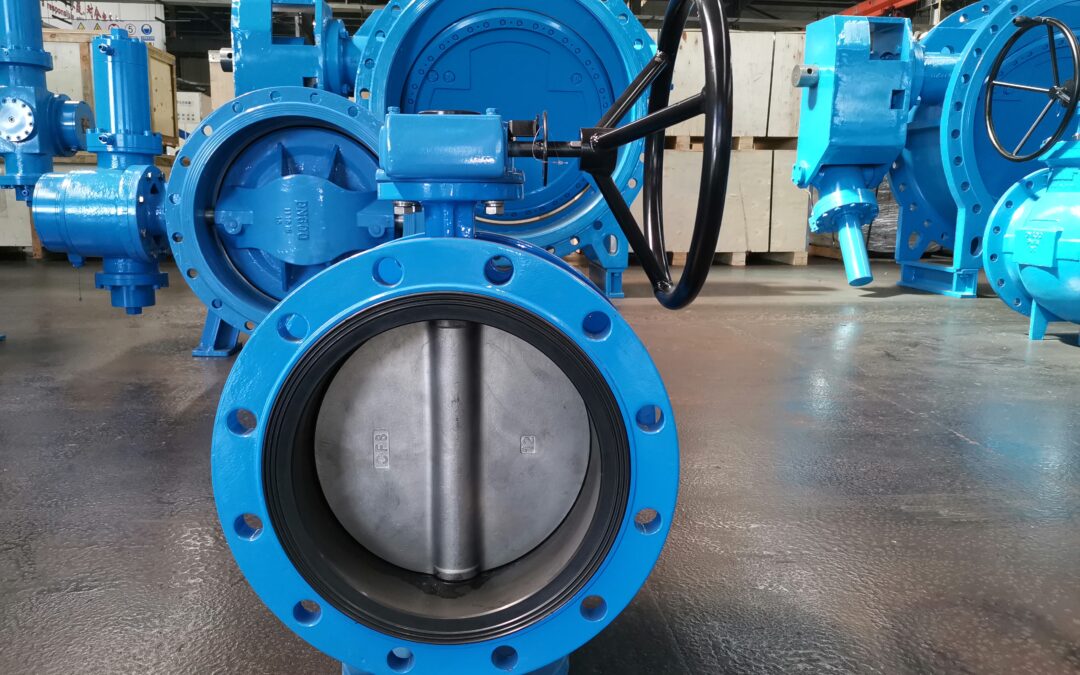
UN vanne papillon triple excentration is a type of valve that combines the benefits of a butterfly valve and a ball valve. It consists of a disk-shaped valve plug that rotates around a central axis, allowing for adjustable flow control. The valve plug has three offsets, which create a cam-like motion when rotated, providing a tight seal and smooth operation.

Features of Triple Offset Butterfly Valves
Triple offset butterfly valves offer several features that make them an ideal choice for industrial flow control.
- Adjustable flow control: The valve plug can rotate to any position between fully open and fully closed, providing precise control over the flow rate.
- High flow rates: Triple offset butterfly valves have a larger flow area than traditional butterfly valves, allowing for higher flow rates and lower pressure drops.
- Low maintenance: The design of the valve plug and the seat ring ensures that there is minimal wear and tear, reducing the need for maintenance and extending the lifespan of the valve.
- Design compact: Triple offset butterfly valves have a compact design. Making them ideal for applications where space limits.
Benefits of Triple Offset Butterfly Valves
The benefits of triple offset butterfly valves make them an excellent choice for industrial flow control.
- Energy efficiency: Triple offset butterfly valves provide efficient flow control, reducing energy consumption and costs.
- Durability: The valve’s design ensures that it can withstand high pressure and temperature fluctuations, making it a durable option for industrial applications.
- Polyvalence: Triple offset butterfly valves can applicate in a variety of applications, including gas, liquid, and slurry flow control.
- Low emission: The valve’s design minimizes the risk of leakage, reducing emissions and ensuring a safer working environment.

Applications of Triple Offset Butterfly Valves
Triple offset butterfly valves have a wide range of applications in various industries.
- Traitement chimique: Triple offset butterfly valves are popular in controlling the flow of corrosive and abrasive chemicals, acids, and bases.
- Production de pétrole et de gaz: The valves can applicate in controlling the flow of oil, and gas. And other hydrocarbons in production, transportation, and refining.
- Traitement de l'eau: Triple offset butterfly valves are popular in controlling the flow of water. And wastewater in treatment plants, ensuring efficient and safe processing.
- Power generation: The valves are popular in power plants to control the flow of steam, gaz, et autres fluides, ensuring efficient energy production.
Conclusion:
En conclusion, triple offset butterfly valves are the ultimate solution for industrial flow control. Their unique design and features provide efficient, durable, and versatile flow control, making them an excellent choice for various industries. By understanding the benefits and applications of triple offset butterfly valves, industries can optimize their flow control processes, reducing costs, improving efficiency, and ensuring a safer working environment.
Août 23, 2023 | More information
TWT Valves as leading wafer type butterfly valve manufacturers en Chine, we always provide quality wafer type butterfly valves, no matter domestic or oversea market. There are 3 famous water projects by using TWT valves:
- East Water Diversion Project in Shenzhen,
- The South-to-North Water Diversion Project,
- The Left Bank Power Station of the Three Gorges of the Yangtze River
Donc, Wafer type butterfly valve with flange own any features?
- UN wafer type butterfly valve flange is a component used to install a wafer style butterfly valve between two pipeline flanges or fittings.
- Contains bolt holes that align with the pipeline flanges to join the valve in between.
- Usually made of steel or stainless steel to match the butterfly valve body material.
- Has a center opening that matches the size of the valve body.
- Comes in standard flange styles like ANSI, DEPUIS, JIS.
- Allows the wafer valve to be bolted securely between two pipeline flanges.
- Contains grooves to accept elastomeric sealing gaskets on both sides.
- The gaskets provide a tight, leak-proof seal between the flanges.
- Flanges are sized to properly support the valve weight and sealing forces.
- Often provides tapped holes for jackscrews to facilitate installation and removal.
- Allows wafer valves to be used in flanged piping systems.

Août 23, 2023 | Nouvelles
When it comes to industrial valves, there are many options available, but two of the most popular types are globe valves and gate valves. Dans cet article, we will compare and contrast these two valve types, discussing their features, avantages, and disadvantages. By the end of this article, you will have a better understanding of which valve is best suited for your industrial needs.
Globe valves vs gate valves are both popular to control the flow of fluids in industrial processes. Cependant, they have some key differences in terms of their design, Fonctionnalité, et candidature.
Globe valves are spherical-shaped valves that have a rotating plug that controls the flow of fluid. They are popular in applications where precise control of flow rate requiring. Such as in chemical processing, oil refining, et production d'électricité.
Vannes, d'autre part, are linear valves that have a sliding gate that opens and closes to control the flow of fluid. They are popular in applications where a high degree of isolation is required, such as in water treatment, production de pétrole et de gaz, and HVAC systems.

Advantages and Disadvantages of Globe Valves
Globe valves have several advantages, y compris:
- Precise control of flow rate: Globe valves designing to provide precise control of flow rate, making them ideal for applications where accuracy is critical.
- Easy maintenance: Globe valves have a simple design that makes them easy to maintain and repair.
- Low pressure drop: Globe valves have a low pressure drop, which means they can handle high-pressure applications with ease.
Cependant, globe valves also have some disadvantages, y compris:
- Limited flow rate: Globe valves have a limited flow rate, which makes them less suitable for applications where high flow rates requiring.
- Limited compatibility: Globe valves are not compatible with all types of fluids, and they may not be suitable for applications where corrosive or abrasive fluids are present.

Advantages and Disadvantages of Gate Valves
Gate valves have several advantages, y compris:
- A high degree of isolation: Gate valves provide a high degree of isolation, making them ideal for applications where a tight seal requiring.
- High flow rate: Gate valves have a high flow rate, which makes them suitable for applications where high flow rates requiring.
- Compatibility: Gate valves are compatible with a wide range of fluids, including corrosive and abrasive fluids.
Cependant, gate valves also have some disadvantages, y compris:
- Limited control: Gate valves do not provide the same level of precise control as globe valves, which can be a limitation in some applications.
- More complex maintenance: Gate valves have a more complex design than globe valves, which can make them more difficult to maintain and repair.

Which is Better for Your Industrial Needs?
En conclusion, both globe valve vs gate valve have their advantages and disadvantages, and the choice between the two will depend on your specific industrial needs. If you require precise control of flow rate and compatibility with a wide range of fluids, a globe valve may be the better choice. Cependant, if you require a high degree of isolation and a high flow rate, a gate valve may be the better option.
When selecting a valve for your industrial application, it is important to consider factors such as flow rate, pression, temperature, and compatibility with the fluid uses. By considering these factors and understanding the differences between globe valves and gate valves. You can make an informed decision about which valve best suits for your needs.
En résumé, globe valves and gate valves are both important types of valves used in industrial processes. Bien qu'ils partagent certaines similitudes, they also have some key differences in terms of design, Fonctionnalité, et candidature. By understanding these differences and considering your specific industrial needs, you can choose the right valve for your application.
Août 22, 2023 | Nouvelles
Ensuring efficient one-directional flow is a vital requirement in piping systems across many industries. To prevent problematic reverse flow and backflow leakage, dual plate check valves offer enhanced shutoff performance compared to standard single disc or swing checks. This article explores the operating principles, avantages, and applications of wafer dual plate check valves (wafer double door check valve).

Operating Principles
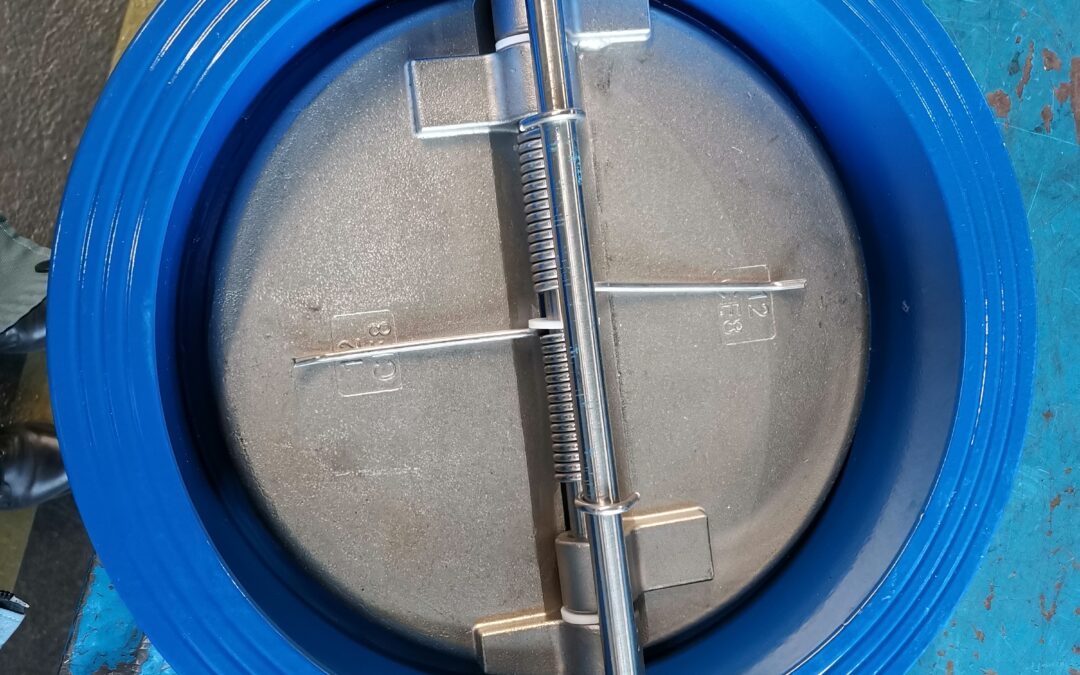
Wafer dual plate check valves contain two spring-loaded discs or closure plates within the valve body. Flow enters through the valve inlet, pushing both discs open. When forward flow stops, the springs force the discs closed against the seat. This forms a tight seal, empêcher le reflux.
The dual disc design provides multiple layers of protection by fully isolating the inlet from outlet. Having two independent discs and seats creates a doubly redundant block against leakage and contamination.
Common Design Variations
Dual disc check valve checks come in wafer, lug, and flanged models to suit different installation requirements. Wafer styles contain a thin valve body that installs between mating pipe flanges. Thicker lug body designs have bolt holes for attaching directly to piping.
Disc configurations include single-hinge double plate, dual-hinge quadruple plate, or tandem single plate with intermediate cavity. Quad plate models provide maximum redundancy. Various materials like nylon, 316 acier inoxydable, fonte ductile, and other alloys are utilized based on durability needs.
Benefits of Dual Plate Checks
Compared to single disc swing checks, dual plate models provide:
- Extremely low forward flow pressure loss
- Tight shutoff and minimal backflow leakage
- Reduced slam and water hammer effects
- Increased blocking capacity against back pressure
- Streamlined wafer body for compact retrofits
- Large internal flow area relative to orifice size
These benefits make wafer dual plate checks ideal for applications requiring tight backflow prevention and low forward flow resistance.
Typical Applications
Industries utilizing wafer dual plate check valves include:
- Wastewater treatment – Prevent backflows from discharge lines.
- Traitement chimique – Block backflows from feed lines.
- Centrales électriques – Eliminate condensate backflows in boilers.
- Fire suppression – Stop backflows in sprinkler systems.
- CVC – Avoid reverse circulating flows in equipment loops.
- Traitement de l'eau – Prevent water system contamination.
Reliable backflow prevention, minimal pressure loss, and robust shutoff make dual plate checks an essential component across water, air, steam, and process line applications. Compact wafer bodies allow easy retrofitting into existing systems.
For critical piping services that demand tight shutoff, wafer dual plate check valves enable reliable one-directional flow control. Their redundant sealing delivers peace of mind across industrial, commercial, and municipalflow applications.
Août 22, 2023 | More information
TWT Valves As Vanne papillon en plaquette de Chine fabricant et fournisseur, we may show you important information related to methods of wafer butterfly valve installation below:
- Inspect the valve and pipeline flanges to ensure surfaces are clean and undamaged.
- Place gaskets on both sides of the valve body. Ensure they are centered and evenly aligned.
- Insert the valve between the two pipeline flanges, aligning the bolt holes.
- Insert bolts through the aligned holes of the pipeline flanges and valve flanges/body.
- Hand tighten nuts in a crisscross pattern to initially secure the valve in place evenly.
- Use a calibrated torque wrench to tighten bolts to the specified torque value in multiple passes. Tighten in a star pattern.
- Check gasket compression and bolt torque values around the valve to ensure an even tight seal.
- Attach the valve actuator and test operation by rotating the disc fully open and closed.
- Measure disc clearance in the valve seat when fully closed on both sides. Adjust as needed.
- Insulate the valve as specified for the process conditions.
- Slowly introduce process flow and check for leaks. Tighten flange bolts further if leaks occur.
- Commission valve by performing several open/close cycles under process conditions.



