
Nov 27, 2023 | Nouvelles
Les vannes papillon sont un élément crucial dans diverses applications industrielles, et choisir le bon type peut être un défi. Cet article compare les vannes papillon à bride et à plaquette, mettre en évidence leurs différences et sélectionner la vanne appropriée pour une application spécifique.
Quand il s'agit de vannes papillon, il existe deux types principaux: type de bride et type de plaquette. Alors que les deux servent le même objectif, ils diffèrent en termes de conception, construction, et candidature. Comprendre ces différences est essentiel pour sélectionner la vanne adaptée à un processus industriel spécifique..

Conception et construction
Les vannes papillon à brides ont une extrémité à bride qui se connecte au tuyau, tandis que l'autre extrémité a une plaque papillon qui tourne 90 degrés pour contrôler le débit de fluide. La vanne papillon de type plaquette, d'autre part, a un appartement, plaque rectangulaire qui s'insère entre deux brides, et le corps de la vanne est boulonné sur les brides.
Applications de la vanne papillon à bride par rapport à la vanne papillon à plaquette
Les vannes papillon à brides sont couramment utilisées dans les applications haute pression, comme les centrales électriques, plantes chimiques, et raffineries. La vanne papillon de type plaquette, avec leur design fin, sont idéaux pour les applications à basse et moyenne pression, comme le traitement de l'eau, Systèmes CVC, et transformation des aliments.
Avantages et inconvénients
Les vannes papillon à brides ont un rapport résistance/poids plus élevé, ce qui les rend adaptés aux applications à haute pression où la durabilité est cruciale. Cependant, elles sont plus chères et plus lourdes que les vannes papillon à plaquettes. Vannes papillon à plaquettes, d'autre part, sont plus légers et plus économiques, mais peut ne pas gérer les pressions élevées aussi efficacement.

Les critères de sélection
Lors du choix entre les vannes papillon à brides et à plaquettes, il est essentiel de prendre en compte les exigences spécifiques de l’application. Si l'application implique des pressions et des températures élevées, une vanne papillon à bride peut être le meilleur choix. Cependant, si l'application est à pression faible à moyenne et nécessite une solution rentable, une vanne papillon à plaquette peut être plus adaptée.
Conclusion:
En conclusion, les vannes papillon à brides et à plaquettes diffèrent en termes de conception, construction, et candidature. Comprendre ces différences peut vous aider à sélectionner la vanne adaptée à votre processus industriel spécifique.. En tenant compte des exigences de l’application et en sélectionnant la vanne appropriée, vous pouvez garantir un flux de fluide fluide et efficace, améliorer les performances globales des processus et la productivité.

Nov 24, 2023 | Nouvelles
Dans les années 1930, les Américains ont inventé la vanne papillon, puis il a été introduit au Japon dans les années 1950, and it was widely adopted in Japan in the 1960s, and it was promoted in China in the 1970s. Although China began to invest in research and production in the field of butterfly valves is not very early, but the speed of development is very high, and the results of development are also very rich. At the beginning, the butterfly valve mechanism is basically based on the middle line butterfly valve, with the improvement of the process and the butterfly valve has been widely used in various fields of the industry, which also makes the demand for the butterfly valve in the industry increased: high temperature resistance, high performance and so on. Demand driven creation, through the efforts of Chinese manufacturers, the performance of the butterfly valve has been further improved, creating a wider range of temperature and pressure, performances d'étanchéité fiables, and longer service life of the butterfly valve. Vanne papillon double excentrique is improved on the basis of single eccentric.
As China’s current first-class double eccentric butterfly valve manufacturer, today TWT wants to talk about double eccentric butterfly valve in detail.
Double eccentric butterfly valves’ improvement process

In order to solve the problem of squeezing the butterfly plate and the seat of the concentric butterfly valve, a single eccentric butterfly valve is first produced, and its structural characteristics are: the stem axis deviates from the center of the butterfly plate. Although this improvement reduces the friction to a certain extent, but the effect is not much better, double eccentric butterfly valve is further improved on the basis of the single eccentric butterfly valve, is currently more widely used butterfly valve, its structural characteristics are: the stem axis deviates from the center of the butterfly plate, but also deviates from the center of the body.
This improvement of the double eccentric butterfly valve greatly eliminates the unnecessary excessive extrusion and scraping phenomenon of the butterfly plate and the seat, reduces the opening resistance, reduces the wear, and improves the life of the seat, so the double eccentric butterfly valve is called a high-performance butterfly valve.
Vanne papillon double excentrique’s working mode
Double offset high performance butterfly valve is mainly composed of valve body, valve plate, valve core, siège de soupape, valve cover, support rod, shaft head, couverture, detector, gasket body and other components.In normal operation, the pressure between the two outlets of the valve body is very small, when the fluid flows, the valve will automatically open to let the fluid flow through; When the fluid is stopped, the valve automatically closes, blocking the fluid flow.
Material of double eccentric butterfly valve
Double eccentric butterfly valves can also use metal seats, which improves the application of butterfly valves in high temperature fields. Cependant, because its sealing principle is a position sealing structure, that is, the sealing surface of the butterfly plate and the seat is in line contact, and the elastic deformation caused by the butterfly plate squeezing the seat produces a sealing effect, so the closing position is very demanding (especially the metal seat). Donc, ductile iron seats are common in double eccentric butterfly valves.
Fonte ductile vanne papillon à double excentrique’s structure is simple and compact, poids léger, good sealing performance, facile à utiliser, widely recognized by the industry.
Application of double eccentric butterfly valve
Double eccentric butterfly valve has the characteristics of good sealing, petite résistance à l'écoulement, corrosion resistance, etc., so it is widely used in the following fields:
- Industrie chimique
- Metallurgical industry
- Power industry
- Oil and natural gas industry
- Food and pharmaceutical industries
If you happen to need a double eccentric butterfly valve, please contact TWT,Chine, we will provide the best quality and the most sincere service.
Nov 23, 2023 | Nouvelles
La vanne papillon est une vanne qui utilise un disque circulaire comme pièce d'ouverture et de fermeture et tourne avec la tige de la vanne pour s'ouvrir., close and adjust the fluid channel. The disc of the butterfly valve is installed in the diameter direction of the pipe. Earlier applications began with the air volume regulation baffle on the flue or chimney, and were also used in low-pressure systems such as ventilation or gas supply. In recent years, the metal seal butterfly valve has developed rapidly, with the application of high temperature resistance, low temperature resistance, strong corrosion resistance, strong erosion resistance, high strength alloy materials in the butterfly valve, so that the metal seal butterfly valve has been widely used in high temperature, low temperature, strong erosion and other working conditions, and partially replaced the globe valve, gate valve and ball valve.
There are many types of butterfly valves, among which the most common classification method is according to the structural form (the position of the rotating center line of the valve stem is different), which can be divided into the following four kinds:
En outre, there are many other ways to classify butterfly valves.
Butterfly valve drive mode classification

Pneumatique actuator vanne papillon
Le pneumatic actuator vanne papillon is composed of a pneumatic actuator and a butterfly valve. The pneumatic butterfly valve is opened and closed with the circular butterfly plate rotating with the valve stem, and the pneumatic valve that has been switched is mainly used as a cut-off valve, which can be used as a switch and adjustment application. Now the butterfly valve is more and more applied in high pressure large and medium diameter pipelines.
Électrique actuator vanne papillon
The electric butterfly valve is driven by an electric actuator, and the working power supply is usually: AC220V, AC380V, etc.. Input signal: 4~20mA 0~10v and other weak signals. After the regulating electric actuator and valve stem are installed and adjusted, the butterfly valve plate is driven by electric energy as the driving force to make a partial reverse rotation movement of 0~90°. Receive the 4~20mA signal of the industrial automation control system to accurately control the valve switching degree, so as to achieve the adjustment and control of different demand parameters such as flow, temperature, pression, etc..
Manual butterfly valve
Manual butterfly valve is a traditional, no mechanized improvement, the need for manual operation of the butterfly valve, although the degree of automation is low, but still plays a relatively large role in the industrial field.
Gate valves also come in many varieties
Like the butterfly valve, the gate valve as a switch valve, there are many classifications. Par exemple:
According to the lifting mode of the stem, the gate valve can be divided into rising stem resilient seated gate valve and non rising stem resilient seated gate valve.
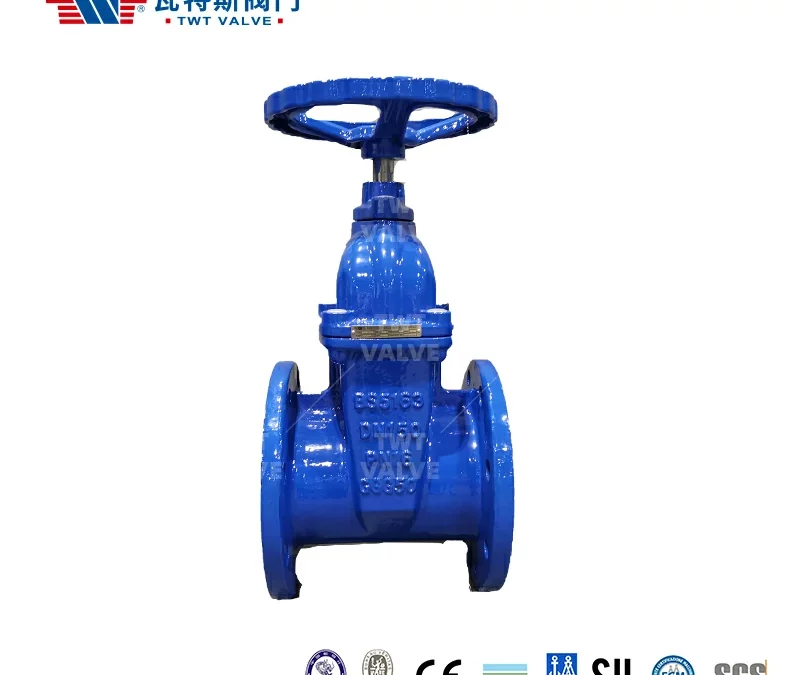
The stem of the vanne à siège résilient à tige non montante only rotates and does not move up and down, and only one valve stem of non rising stem resilient seated gate valve is exposed. Its nut is fixed on the gate, through the rotation of the stem to lift the gate, so you can not see the door frame; The stem of the rising stem resilient seated gate valve is exposed, and the nut is fixed tightly to the handwheel (no rotation, no axial movement). By rotating the stem to lift the gate, the stem and gate only have relative rotation movement, there is no relative axial displacement, and the appearance is a portal bracket.
China high quality butterfly and gate vales here
TWT is a professional valve manufacturer in China, known for high quality and excellent service, all kinds of valves we have professional production lines to ensure to meet your needs. Dans cet article, we briefly mentioned several commonly used butterfly valves and gate valves, which are also part of our main products. You are welcome to continue browsing our website for more information.

Nov 23, 2023 | Nouvelles
Cet article propose une exploration approfondie des clapets anti-retour à battant, leur fonctionnalité, et leur importance dans les systèmes de contrôle de flux. Un clapet anti-retour à battant est un élément crucial utilisé pour réguler la direction de l'écoulement des fluides dans les canalisations.. En permettant l'écoulement dans une direction et en empêchant le reflux, ces vannes assurent le bon fonctionnement et la protection des systèmes de tuyauterie.
Clapets anti-retour à battant: Solutions de contrôle de flux fiables
Swing check valves are indispensable devices utilized in flow control systems to manage the direction of fluid flow effectively. This comprehensive article aims to elucidate the functionality, avantages, and applications of swing check valves, shedding light on their critical role in maintaining optimal flow control.

Understanding the Function of a Swing Check Valve:
A swing check valve operates on a simple yet efficient mechanism. It consists of a hinged disc that swings freely within the valve body. When the flow is in the desired direction, the disc is pushed open, allowing fluid passage. Inversement, when the flow tries to reverse, the disc swings back into place, sealing the valve and preventing backflow. This functionality ensures uninterrupted flow while protecting the system from potential damage.
Benefits and Applications of Swing Check Valves:
- Empêche le reflux: Swing check valves effectively prevent the reversal of fluid flow, safeguarding equipment and pipelines from damage caused by backflow pressure.
- Low Pressure Drop: These valves offer minimal resistance to flow, resulting in lower pressure drop across the system and improved energy efficiency.
- Polyvalence: Swing check valves find applications in various industries, including wastewater treatment, pétrole et gaz, la production d'énergie, et traitement chimique. They are suitable for both horizontal and vertical installations.
- Entretien facile: Swing check valves are typically designed for easy maintenance, allowing for quick inspection and cleaning of the valve seat and disc.

Example:
For instance, in the water treatment industry, swing check valves are commonly used in pumping stations and sewage treatment plants. They enable efficient water flow while preventing the backflow of contaminated water into the clean supply. This ensures the delivery of safe and clean water to consumers while protecting the integrity of the system.
En conclusion, swing check valves play a vital role in maintaining efficient flow control in various industries. Their ability to prevent backflow and minimize pressure drop enhances the performance and longevity of piping systems.
With their versatility and ease of maintenance, swing check valves are reliable solutions for regulating fluid flow effectively. Incorporating swing check valves into flow control systems ensures the smooth operation and protection of critical equipment.

Nov 22, 2023 | Nouvelles
Les vannes papillon de type A sont des unités d'exécution importantes dans le domaine du contrôle de l'automatisation industrielle, et peut être utilisé comme vanne d'arrêt, control valves and check valves for piping systems. With manual control device, once the power failure, you can temporarily use manual operation, will not affect the use of. Suitable for situations where flow regulation is required. Because the pressure loss of the a-type butterfly valve in the pipeline is relatively large, about three times that of the gate valve (vanne à vanne de grande taille), when selecting the butterfly valve, the impact of the pipeline system by the pressure loss should be fully considered, and the robustness of the butterfly plate under the pressure of the pipeline medium should also be considered when it is closed.
At this time, TOP,China feel it necessary to mention that in addition to the a-type butterfly valve, there is also a vanne papillon.
The basic composition and use of butterfly valve

The butterfly valve is made of rubber sealing material and carbon steel or stainless steel valve plate and stem.
- Butterfly valves can be used for gas pipelines in sulfuric acid industry: furnace blower inlet and outlet, relay fan inlet and outlet, electric defog series and connection valve, S02 main blower inlet and outlet, converter adjustment, preheater inlet and outlet and cut-off gas use.
- Butterfly valve is used in sulfur acid system burning sulfur, transformation, dry suction section, is the brand of sulfur acid device valve, which is considered by the majority of users as: good sealing performance, light operation, auxiliary corrosion, high temperature resistance, easy operation, flexible, safe and reliable butterfly valve, has been widely promoted and used.
- Butterfly valves are also widely used in: chimique, pétrochimique, smelting, médecine, food and other industries in SO2, steam, air, gaz, ammonia, CO2 gas, huile, water, salt water, lye, seawater, nitric acid, hydrochloric acid, sulfuric acid, phosphoric acid and other media of the pipeline as a regulating and intercepting device used.
Difference between a & vanne papillon
The difference between the lt vanne papillon and the a-type butterfly valve is the connection and installation method, the a-type butterfly valve can be installed in the middle of the pipeline, and thelt butterfly valve can be installed in the middle of the pipeline or at the end of the pipeline.
The lt butterfly valve and the a-type butterfly valve are the same in structure, performance and material of the parts, only different from the a-type butterfly valve can be connected between the two pipe flanges through the double-headed bolt (or extended hexagon bolt). In addition to connecting between two pipelines through two sets of ordinary hexagonal bolts, the lt butterfly valve can also be installed at the end of the empty pipe.
A special butterfly valve with large diameter
Chine Vanne papillon de type U is a type of butterfly valve that is designed to handle particularly thick or viscous fluids, such as slurries, powders, and granules. It gets its name from the shape of its disc, which is U type and has a larger opening area compared to other types of butterfly valves.
U-type butterfly valve is a kind of regulating valve with special structure, which can be used for switching control of low-pressure pipeline medium. U-type butterfly valve refers to a valve whose closing part (valve disc or butterfly plate) is a disk and rotates around the valve shaft to achieve opening and closing. It can be used to control the flow of various types of fluids.
Characteristics of U type vanne papillon:
1, excellent bidirectional sealing performance, small torque value;
2, U-type butterfly valve flow characteristics tend to be straight, good adjustment performance;
3, lining connection and installation is convenient, vertical, horizontal installation can be;
4, the diversity of sealing materials, available for users to choose;
5, U-type butterfly valve valve can be used for pipe end as a vent valve, reliable performance;
6, the valve seat sealing ring and the valve body are organically integrated into one, so that the valve has a long service life.
As leading manufacturer and supplier in China of steel valves products, TWT provides quality butterfly valves, en même temps, we also supply kinds of gate valves, such as big size gate valve. Please contact us for more informations about gate valves products.



